


The Power of the Pause

You know that feeling when your chest tightens, your mind starts racing, and before you even realize what’s happening, you’ve said something you didn’t mean, agreed to something you didn’t really want to do, or you’ve spiraled into overthinking for the rest of the day?
Yep. That moment. It is so fast, right?
It’s automatic. And if you’re like most of us, it happens a lot more often than you would like to admit.
How often do we move through our days on autopilot? Always one step behind, uh, two steps behind, or reacting to life instead of responding with intention. And by the end of the day, it can feel like everything pulled at your energy and you didn’t get a say in any of it.
But here’s the good news. You do have a say. And learning how to stop reacting and start responding starts with something simple.
A pause.
Not a long one. I know it can feel uncomfortable to slow down, to just be. So pause just enough to notice. Just enough to breathe. Just enough to come back to yourself before you respond.
And that tiny pause can change so much. It’s the key to how to stop reacting and start responding in a way that feels aligned with who you truly are.
When you create space between what’s happening and how you choose to respond, you stop living in reaction mode. You get to respond from your values, from your boundaries, and from your inner peace. And I’ll tell you, that shift ripples into every part of your life and changes your work, your relationships, your energy, and even the way that you talk to yourself.
So in today’s episode, I’m going to be sharing three simple tools that you can use anytime and anywhere to help you stop reacting on autopilot and start responding with more clarity, more calm, and more intention.
Now you don’t need anything fancy, so don’t worry. You don’t even need a full hour to yourself (though we would both love that, wouldn’t we?). You just need a little willingness to pause, to check in, and then choose on purpose.
Let’s take a breath together… and dive in.

Table of Contents
Practice 1: The 60 Second Breath Reset
A quick way to stop reacting and respond with calm when everything feels too much
All right, so the first practice that I want to share with you today is the 60 second breath reset. And I love this because it is a quick way to come back to yourself when everything feels like too much.
Now here’s the thing. When your nervous system is flooded, whether you feel stressed out, whether you’re anxious or overwhelmed, or even if you’re angry, it’s really hard to access logic or compassion or clarity, right? Your brain is busy trying to protect you. And that is why you react the way you do.
This breath reset helps to calm your body so that you can think clearly again. It signals to your system that you’re safe, which can make it easier to pause and respond with intention instead of snapping or shutting down.
And the best part is that it takes less than a minute.
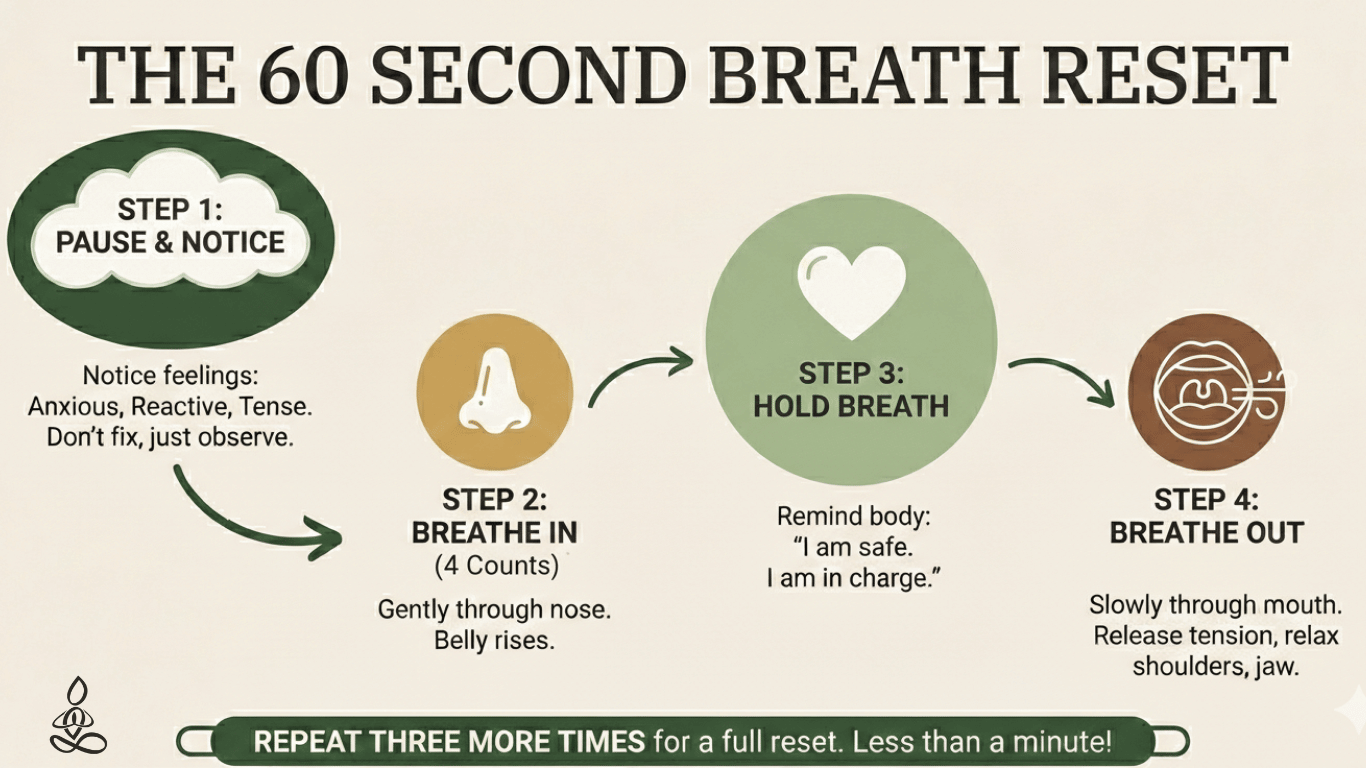
The 4-7-8 Breath Pattern
Here’s how to do it
Step one: Pause
You don’t have to fix anything. Just notice what’s happening.
I feel anxious.
I want to react.
My body feels tense.
Just notice.
Step two: Inhale through your nose for four counts
Inhale, let your belly rise. Don’t force it. Just breathe gently.
Step three: Hold the breath for seven counts
This reminds the body that you are in charge and that you are safe.
Step four: Exhale slowly through your mouth for eight counts
And you really want to release everything here that you can. Feel your shoulders soften. Let your jaw relax.
Repeat three times
So you’re going to breathe in for four through your nose, hold the breath at the top for the count of seven, and then breathe out through your mouth for a count of eight. And that’s it. In less than a minute, you’ll feel your body relax, your thoughts slow down, and a sense of space open up inside you where you can choose how you actually want to respond next.
And the best part about this is that you can use this breath reset anytime. Before you reply to a difficult text. During a tough conversation. When someone says something that triggers you and you feel yourself starting to react. It’s really subtle and you can do it anywhere, and I think the best part is that you can do it without anybody even noticing.
Why it works
So why it works is because when your body calms down, your brain comes back online. And so don’t worry, it’s not about doing it perfectly. It’s just about giving yourself a moment to return to your center instead of reacting from a place of stress or fear.
Inside my coaching work
Now inside my coaching work, we take this breath practice and we make it personal. So I help my clients learn what their stress responses look like and feel like so that they can catch them sooner, and so it makes it easier to respond with more intention.
We explore breath patterns that suit their unique bodies, somatic practices that release tension, and daily rituals that support nervous system regulation over time.
This, my friend, is the foundation. Once you know how to stay grounded in your body, everything else becomes easier: communication, boundaries, self-trust, and emotional resilience.
Practice 2: Name It to Tame It
How to respond with awareness instead of reacting from habit
All right. Now the second practice that I want to share with you today is name it to tame it. And here we’re talking really about how to build awareness instead of reacting from habit.
So once you’ve calmed your body, the next step is to understand what is happening inside of you.
And so just think about it. Most of the time we react without knowing why. We don’t question it. Something happens and suddenly we’re irritated or anxious, or we’re saying yes again on autopilot when really we wanted to say no. And so if we don’t stop to check in, we end up acting from these old habits or emotions that haven’t been fully understood.
That’s why this step is all about naming what you feel. And I know it might sound simple, but it is one of the most powerful things that you can do.
Why Naming Your Emotions Changes Everything
When you name what’s happening without judgment (there’s no judgment here), when you name what’s happening, you give your brain space to slow down. You stop being controlled by the emotion, and you start making choices from awareness instead of reactivity.
So you want to put it into practice? Let’s give it a go.
How to practice it
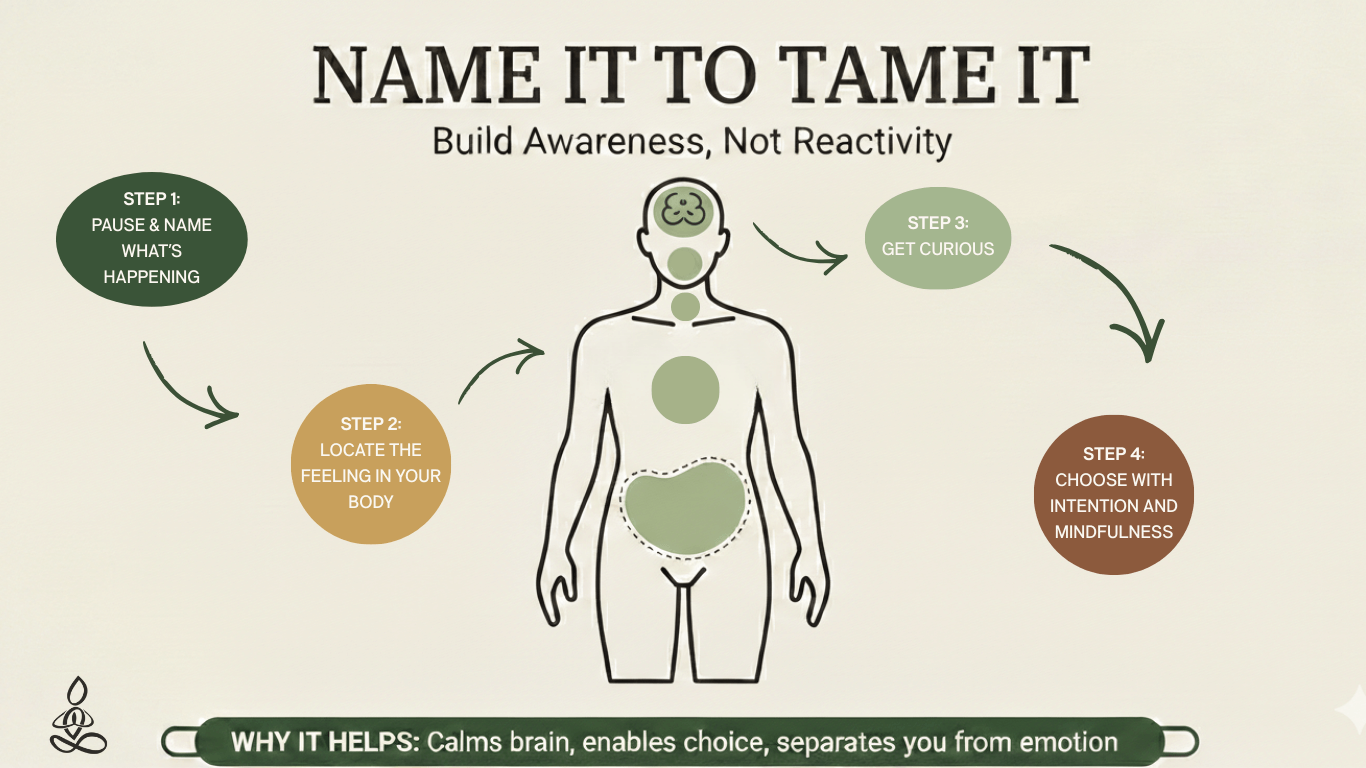
Step one: Pause and acknowledge what’s happening
All right. The first step is to pause. We introduced the power of the pause in episode two, so I’m having fun expanding on that today.
Say it just quietly to yourself in your mind.
I feel anxious and scattered.
I feel frustrated and tense.
I feel hurt and unseen.
There’s no right answer. There’s no wrong answer. You’re simply noticing. And I like to think about it like, you know, when you pick up your phone and you check the weather app? It’s kind of like checking the weather inside your body. There’s no right or wrong. Like maybe it’s raining today, maybe it’s snowing today. It is what it is. So what is the weather inside your body? Notice how you feel. Notice what’s happening.
Step two: Locate the feeling in your body
And this can be more subtle. It depends on the circumstance, right? But just ask yourself, am I feeling this in my chest, in my stomach, in my shoulders, in my jaw? Even just asking this question, it pulls you out of your head and back into your body.
Step three: Get curious
Ask yourself gentle questions.
What might this feeling be trying to tell me?
What do I need right now?
Is there another way that I could respond?
Be curious. Be open-minded.
Step four: Choose your next step
And then step four is where you get to choose with intention and mindfulness your next step. Because once you understand what’s happening, you can respond in a way that feels aligned with who you are. Maybe you take a big breath, maybe you set a healthy boundary. Maybe you choose to pause and put your thoughts together before speaking.
Why this helps
So why does this help? Well, naming the emotion calms the part of your brain that wants to react to it. It activates the thinking part of your mind so that you can choose your response more clearly.
You also stop identifying as the emotion. You are not anger. You are not anxiety. You are a human being who feels those things. Powerful, right? Let’s think about that again. You are not the anger. You are not the anxiety. You are the human being who is feeling those things, and as a human being, you have choices.
Inside my coaching work
So now inside my coaching work, this is where we start really connecting the dots. Together we get to explore the patterns behind your emotions and why certain situations trigger you. We expand your emotional vocabulary so you can describe what you feel with more precision, which helps to change how you choose to respond.
We also use tools like journaling prompts, like body-based awareness practices, and mindfulness techniques that help you turn awareness into mindful, aligned action.
The goal here is not to overanalyze. Trust me, I know how to go down that hole. It’s to gently notice what’s real so that you can meet it with compassion and you can respond with a deeper sense of clarity.
Practice 3: Ask What’s the Next Right Thing
How to respond intentionally and move forward without overthinking
All right, my friend. Let’s dive into our third practice today, and that is to ask, what’s the next right thing? Simple question to help you move forward without overthinking. Wouldn’t we all love that?
So once you’ve calmed your body and named what you’re feeling, it’s time to choose your next step. And this is where you really step back into your power, not by solving everything at once, but by taking one small step forward.
And this is probably one of my favorite practices.
It is so easy to think that we need the whole plan before we can act. But you’ve heard the saying, the journey of a thousand miles begins with a single step, right? That pressure to have the whole plan, to have it all figured out, that is what keeps us stuck. Right?
So instead, let go of the plan for now and focus on the next right thing. Just one small, doable step that helps you move forward.
The Simple Practice
How do we practice it?
Pause and breathe
You knew that was coming, right? Pause and breathe. Even one breath in, one breath out will help. Let’s do it together now. Go ahead and empty your breath and then offer yourself a long, slow, deep breath in and let’s breath all the way back out.
So even that breath in, breath out, that can help, right?
Ask yourself
And then ask yourself, what’s the next right thing I can do in this moment? Or, if it feels better, what’s the next best thing I can do in this moment? Because it’s not always right or wrong, it’s not always black and white. Sometimes it’s just picking the best that we can.
And my invitation to you is to keep it small. Perhaps it’s drinking water. Maybe sending a text message to a friend you’ve been thinking about, someone you haven’t talked to in a while. Or setting down your phone to go for a walk. Even deciding to do nothing at all right now. All of those are choices.
Listen to your body
All right. The next step is to listen to your body. Notice how each option feels. Does it feel light and clear, or tight and heavy? We’ve talked about this before, but your body often knows the truth before your mind does.
Take the step
And then, ah, the hard part. Take action. Take the step, even if it’s tiny, even if you’re uncertain. One small step, it’s going to help you to build trust and it’s going to keep you in motion.
Building Trust Through Small Steps
Why this works
So why does this work? Well, this practice stops the cycle of overthinking (I know we all need relief from that at some time or other), and it builds confidence in your abilities to choose. You don’t need to know every single step. You don’t have to have it all figured out. We want to, but you don’t have to.
And again, I’ll come back to that saying from Lao Tzu: the journey of a thousand miles begins with a single step. You just need to choose the next step. Over time, this strengthens your trust in yourself and makes aligned decision-making almost like it’s second nature.
Inside my coaching work
Now inside my coaching work, this practice becomes a part of daily life. I get to help my clients tune into their bodies and tune into their intuition so that they can hear the quiet signals that are guiding them.
We identify patterns that cause overthinking, rewrite the stories that feed fear, and create mindful rituals that fit into daily life that make decision-making feel more natural and more grounded.
We also practice boundary-setting and communication tools so that choosing the next right thing or the next best thing doesn’t feel so overwhelming. And so this is where you get to shift from reacting to creating, and your life really starts to feel like it truly belongs to you.

You might be wondering
Does something this simple really make a difference?
Now, I know you might be wondering, does something this simple really make a difference?
And it’s a really good question.
Because we’ve been taught, think about it, that real change has to be dramatic, that it has to be difficult. The belief is that we have to overhaul everything, start over, start from scratch before anything gets better. And I don’t think that’s true.
Lasting change, in my experience, it usually happens through small, consistent shifts over time. A single breath that calms your body. A pause that helps you name what’s going on. One intentional, mindful choice that changes how you show up in your world.
These tiny moments, they might not seem like much, but they help to rewire your nervous system. They help you build self-trust, and they shape how you move through your one wild and precious life (to quote Mary Oliver).
And what I really love about these practices, the best part is that you don’t have to do them perfectly. No perfectionism here. We don’t need it. Let it go. One conscious pause a day is a win. One breath before an unconscious reaction, that’s growth. And over time, these small moments, they add up to a life that feels more grounded, more peaceful, and more aligned from the inside out.
In summary
So we’ve covered a lot today. Here’s what we’ve covered about how to stop reacting and start responding with more intention:
- A breath practice to regulate your nervous system (the 4-7-8 breathing pattern)
- A way to name your emotions and to respond with awareness
- A question that helps you choose your next step with more clarity and intention
And again, these practices are simple but powerful. I got to interview Suzanne McCahill Perrine in episode 16 of the Magic Mindfulness podcast, and she reminded us that simple does not always mean easy.
And so these practices, they’re simple, not necessarily easy, but they are powerful. These tools help you to feel more present, more grounded, and more like yourself, no matter what life throws your way. And when that becomes your new normal, oh my gosh, everything changes.
Ready for deeper support?
So thank you so much for joining me for this series. If this series has resonated with you, if you’re craving more than just tools, if you are ready for real, lasting change that is grounded in who you are, I would be honored to walk that path with you, my friend.
This is the exact kind of work that we get to do inside my 1:1 Soulful Life Coaching.
It’s a personalized, supportive space to slow down enough to tune in so that you can move forward with more clarity, more calm, and more self-trust, not by doing more, but by coming home to yourself to the truth of who you are underneath it all.
You don’t have to figure it all out alone. And you certainly don’t need to do it perfectly. I don’t even know what that would mean. You just have to be willing to begin.
Learn more and apply at rachelhupp.com/coaching
If something in you is whispering, “This is what I need,” I invite you to trust that. It is the first step back home to the heart of who you are.
And if this episode spoke to you, I would love to hear about it. Leave a comment or share it with someone who could use a little bit of extra support this week.
And I would love to invite you to make sure you’re subscribed so you don’t miss the next episode. I’ve got more simple but powerful tools coming your way.
So stay tuned, and I will meet you there.
Rachel


Comments Off on 3 Simple Practices to Help You Respond (Instead of React)