


Welcome to Radiantly Rooted with Rachel. Today I am sitting down with someone who brings so much heart and intention to midlife. Cheryl Dillon, a certified life coach, writer, and founder of Funderful Experiences.
As a certified life coach and connection expert, Cheryl has spent more than 15 years helping people not just survive, but thrive through major life transitions. With a background in psychology, professional training from the Institute of Professional Excellence in Coaching, and certification in event planning from San Diego State University, she blends emotional insight with thoughtful design to craft experiences that are both uplifting and transformative.
Her own midlife turning point inspired her work, and now she teaches women how to create lives that feel vibrant and true to who they are.
I am so excited to chat with her today about becoming your own best friend in midlife and why that inner relationship shapes everything else.
You can watch on YouTube, listen on your favorite podcast platform, or keep reading below.
Editor’s Note: This transcript has been lightly edited for formatting and ease of reading. While I’ve done my best to ensure accuracy, some transcription errors may occur. For the full conversation, please watch the video above or tune in on your favorite podcasting platform.
In This Conversation
Midlife Wasn’t a Crisis, But a Turning Point
Rachel: So, Cheryl, you have said that midlife wasn’t a crisis for you, but a turning point. How did you know that you wanted something different for yourself?
Cheryl: That is a great question. Before, you know, really it wasn’t one significant event. It’s a whole bunch of things that were happening in a short time period.
One of the things is I’ve been self-employed for more than 20 years. My primary business is with my husband and partner, and we’ve been helping couples peacefully divorce without lawyers for more than 17 years. He’s a divorce mediator and I’m a divorce coach. I’ve been previously divorced, and it’s strange to say it because Joe and I have been married for 20 years this year.
But I do know what it’s like to go through a significant life event such as a divorce, and I really have a passion for helping people avoid the ugly, you know, adversarial, stressful, expensive process. So, you know, working in the mediation practice has been very fulfilling for a lot of years, personally, of course, and professionally.
But I’m sure you can appreciate a couple of things. First, mediation is a confidential process. So it’s not like I’m going to go to lunch with my client and be friends with them. After people are finished working with us, with good reason, they don’t want to ever talk to us again. You know, it’s a painful chapter. They want to heal and move forward, and I completely get that.
So it’s a little bit lonely sometimes to not have the camaraderie, you know, going out to lunch with colleagues or not to have clients who become friends that you can spend time with.
The Wake-Up Call
At the same time, I went to go visit my mother who turned 80 last January. And it was the first time I had seen her in about two years. I just was very upset to see that she really was in her chair a lot, playing video games, watching a lot of television, not out and socializing, or her version of it is not the same as my version of it.
And it really struck me about, you know, your life and how much time you might have left and how you want to be spending it. And I just really got this very strong feeling that I don’t want that for my life and I need to start making some very deliberate changes right now to build the foundation for the future.
So then that’s kind of started happening. My father passed away when he was 58 and I’m 56. So that’s kind of in there too. Again, this reality check of mortality and, you know, in midlife you kind of have an eye on that and things in life, your priorities change.
Um, I moved to California from Chicago in 2018 and after settling into our home, the pandemic hit. And so again, I really didn’t have an opportunity to go out in the community, make friends, have a sense of connection, a sense of purpose. Friends, I always wanted a group of wonderful girlfriends.
And so for all these years, I really just feel like something big is missing, and that really culminated in my desire to go back to school for event planning.
Finding Connection Through Awareness
Rachel: I love that. Thank you so much for sharing. There’s so many nuggets of wisdom that you shared in that segment. Like one, most of the women that I work with, most of the women that come to me, they tell me it was not just one big thing. It was a culmination of things that helped them to realize that, whoa, you know, I need to make some changes in my life.
And I could totally relate to your story about your mom, because my own mom had her first stroke when she was only 49 years old. She passed away a few years ago, but I’m 46, and so I have to be very mindful about how I’m taking care of myself and the boundaries that I’m setting. And so I could just really relate to how you see what somebody else has struggled with or is struggling with and how that can give you the motivation that you need to be a little bit more mindful about how you are choosing to live your life.
Cheryl: Yeah.
Creating Funderful Experiences
Rachel: So it sounds like all of these experiences kind of gave you the inspiration for creating your Funderful Experiences. Do you want to tell our listeners about that?
Cheryl: I was at the kitchen table with my husband and we were just scrolling. It was a Sunday, I think we were reading the 1440, which is like a non-politicized news feed. And I think some story came in there and it was talking about how people in midlife and older are looking for meaningful experiences.
So not so much material items anymore. The things that are important when you’re younger, you know, growing your career, making more money, buying things, having status, those things were falling away and that what people were looking for were meaningful experiences.
So that term just kind of hung there for a minute, the meaningful experiences, and then I went into the dining room and I was doing a jigsaw puzzle because that is something that helps me relax and get out of my head and just, you know, I love puzzles and that was still in there. And I said, “Fun, Funderful Experiences. That’s it.”
The Shift from Material to Meaningful
And so it was really, I just was sitting with the meaningful experiences and that really connected with me also enjoying these days. And it doesn’t have to be giant travel or anything grandiose. It can be having meaningful experiences in the everyday. And so the name kind of stuck.
The Evolution of an Idea
So then once that was there, then it was like, okay, well what’s my company going to be? And I went through a couple of iterations. One was because I was in an events planning program, one idea I had was that I would plan meaningful, wonderful experiences for other people. So they would hire me and I would create some kind of experience for them and their friends or their guests.
Then the next iteration was, I’m going to take people on these trips and these meaningful experiences and I’ll be the host and plan it all out. But then, you know, it’s like you have an idea, you start kind of fleshing it out and it’s like, well that’s not really going to be everything I’m looking for. That’s not going to really do it for me.
And then I decided I want to create my own events. I want to meet with people in person. That’s what I love. I love the energy of being in the same space with other people.
Craving Genuine Community
For my whole life, I’ve been craving a big group of actual, like, genuine female friends, not the kind that are fake, not the kind that are cliquey or competitive, truly drama-free and really supportive. I’ve been lucky to find one here, one there, but never a group. And I won’t give up on that. I think it’s possible if the space is right.
And so I decided that’s what I want to do. I’m going to create in-person experiences, a community where we all abide by certain rules, you know, ways that we’re going to treat each other in the space, ways that we’re going to be. And that this is going to be the wonderful, supportive community that’s with me however much longer I’m here on the planet.
Rachel: I love that. Thank you so much for sharing. There are a couple bits that you shared that I want to reflect on if I may. One, I love that the inspiration for the name came to you while you were doing a puzzle because so many of us, we don’t have those tools for stress relief or for when we get stuck in our head with all these cycles of ruminating thoughts. And for me it’s coloring. I love coloring books. And so I love that you shared that, you know, when you gave yourself some time to unwind, to have fun, to take your mind off of things, inspiration hit.
I think that that is just a really fun way to come up with a Funderful Experience’s name. And something else that you shared really stuck with me. I was having a conversation with a woman the other day about how at this age, you’re totally right, we don’t need to strive anymore. We’ve achieved a certain level of success. I’m not interested in climbing the corporate ladder anymore. I’m interested in fulfillment, in things that bring me joy, in these meaningful experiences like what you’re creating for people and in the supportive feminine community that you talked about. I got goosebumps when you talked about that.
Cheryl: Yeah, for sure. I think a lot of us, when you say ruminate, you just can’t stop the narrative. It’s nonstop in your brain. It’s terrible. It’s consuming, it often is negative and it’s a lot of worries and a lot of fear, replaying things and worrying about things that haven’t happened. And it just, you know, I think a lot of us, it’s just maybe our conditioning, how we grew up or what we’re used to, but it’s autopilot and unless you can somehow take a pause and get an awareness of it, that’s really the only time that you can start to address it.
If you don’t have the awareness, you’re just, again, going about your day. It’s automatic. But if you have a break, for me it’s puzzles. It is gardening. Singing for me. It’s these things that you love to do where you have no sense of time and you feel so relaxed and so in the flow of what you’re doing. All the best ideas come. You’re at peace, you feel happy, relaxed. It’s just such a wonderful feeling.
So I think that if everybody can incorporate more of that naturally into their day, again, it doesn’t have to be a big grand thing. The puzzle for 10 minutes after breakfast, but just something that gives you the awareness and lets you kind of come back to yourself so that you can feel more grounded and more you.
Finding Stillness in the Chaos
Rachel: Yes, I totally agree with you. Awareness is that first step and just, it doesn’t have to take long. It doesn’t have to be big. It just has to be meaningful to you.
What It Means to Become Your Own Best Friend
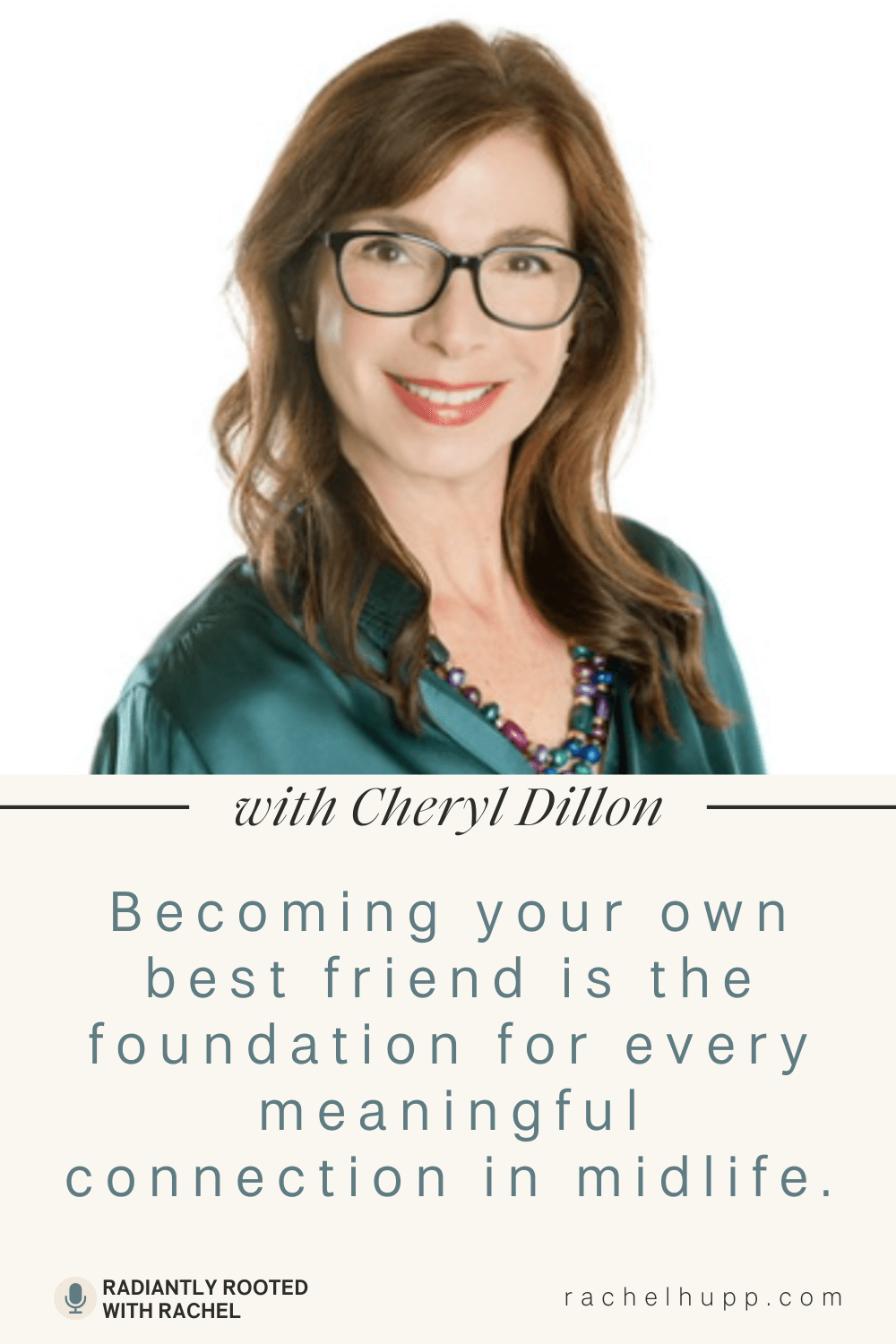
Rachel: So, Cheryl, we’ve talked about community and connection and you shared with me that you really help women learn to become their own best friend. And so that relationship that we have with ourselves is so important. So when you talk about becoming your own best friend, what does that mean in practice?
Cheryl: It means a lot of things. I think, you know, being your own best friend, first of all, it’s how you talk to yourself. That ruminating, you know? We’re in our head. It’s our own critic, the inner critic. You know, in coaching there’s all kinds of names for it. Some people call it the gremlin. Some people call it the inner critic. You know, there’s all kinds of names for it.
In coaching school, I learned gremlin was the term that we were using, but it’s your inner critic and it’s that voice inside your head that always tells you you’re not something enough.
“If we treated our best friends the way we’re treating ourselves, it’s such a difference.”
If we treated our best friends the way we’re treating ourselves, you know, it’s such a difference. So I think being a friend to yourself is taking a very deliberate look at how you speak to yourself. Even the things you say out loud. Sometimes I’ll talk to somebody and I’ll say, “Oh, I was, I’m so stupid.” No, you don’t want to say that.
Words Carry Energy
Again, these words carry a lot of energy. They carry a lot of weight. And so the thoughts you’re thinking, the words you’re speaking, they influence your emotions, how you feel. They influence the actions you take, the choices you make, the behaviors, which feed right back into the thoughts.
Start with Self-Compassion
So for me, being your own best friend is sort of like faking it until you make it. Telling yourself, “I love myself,” which is so strange for people to even say. If I asked you to say that out loud, “I love myself,” it doesn’t come naturally to many people. They don’t feel that. It feels disingenuous, uncomfortable. They don’t believe it.
And so it’s just starting to again, have this awareness of the words that you’re saying to yourself, out loud and in your mind, and saying nicer things. Because if you start to cultivate that self-love, or at least self-compassion, and be gentle with yourself, you’re going to immediately feel better.
Your emotions are going to be different. You’re not going to be feeling so angry or depressed or frustrated or guilt, you know, filled with guilt or shame. It’s going to bring your energy up. If your energy is up, you’re going to take kinder actions. Maybe you’ll eat better, maybe you’ll exercise, maybe you will make choices in your life that are more aligned with being a friend to yourself instead of punishing yourself and keeping you in the loop.
Rachel: Yes, I love that. And it’s like a drop in a pond, that ripple effect. One small action ripples out into other areas of your life. In yoga, that’s a concept called ahimsa, and it’s often translated as nonviolence, but it’s really more about compassion and action, active nonviolence, active non-harming. And meaning, are we being kind and compassionate, not only to those around us, but are we taking that same compassion that we would share with the world around us and honoring ourselves with that same level of compassion?
And to your point, it’s all about building that mindful awareness around it. Like noticing how we’re talking to ourselves, noticing how we’re talking about ourselves, and giving ourselves a little grace, giving ourselves a little compassion, treating ourselves like we would treat our best friend.
The Power of Reframing
Cheryl: Definitely. And I think a lot of it too is reframing. So that’s, you know, again, the benefit of being a coach is I get to coach myself. I do, I do coach myself on basically a minute-by-minute basis. You know, I’ll go through, so I have the tools, you know, but it’s kind of like the shoemaker’s kids who don’t have shoes. Sometimes you have all the tools, but you also have to follow them. You know, it’s easy for me to dish it out to other people, but to actually follow it myself.
But that’s something else I’ve been doing more consciously this past year, because I noticed one of the reasons I didn’t have the group of wonderful female friends is because I wasn’t being a good friend to myself.
“One of the reasons I didn’t have the group of wonderful female friends is because I wasn’t being a good friend to myself.”

And so I feel what you, your energy, what you’re sending out is attracting right back to you. And so, in making some of these conscious changes and speaking to myself more kindly and with more love and supporting myself more, has brought my energy up and it’s attracted some awesome friendships this year into my life.
So, you know, it works, but it’s something you have to do all the time, changing the narrative. So sometimes, you know, it’s going to be uncomfortable when you first start to do it. It’s not natural. It will be deliberate and you won’t always get it. You will say something mean to yourself or you will think something that’s maybe not so kind about yourself. It’s okay if you can catch it and reframe it.
The Coaching Tool: What’s Another Way?
And so something that I think is really powerful is to say, “What’s another way of looking at that?”
Rachel: Yes.
Cheryl: And that’s one of the coaching tools. Okay. Hold on. Stop sign.
Rachel: Yes, yes. I love it.
Cheryl: What’s another way of looking at that? I’ll come up with two or three other more empowering ways of looking at the same situation, and then I’ll choose the one I’m going to believe. Because in a lot of these situations, you never really know the real answer. So you get to choose which one is most empowering, and again, brings your energy up and it helps you feel better about whatever it is that you’re worrying about.
So I think that’s a very powerful tool. What’s another way of looking at that? And then to reframe what you just said into a more empowering thought or phrase.
Rachel: Yes, exactly. It’s about, I feel like the more you notice, the better you get at noticing. Like at first you’re so used to the way you talk to yourself, like you don’t even notice. And then as you get in the habit, like you said, stop, I love that visualization, stop. But the more like, it’s without judgment, it’s just being curious. But the more you notice, the more you start to notice and the more opportunities you have to reframe. And that is so empowering. It is so powerful.
Stop Apologizing
Cheryl: I think a lot of women also apologize.
Rachel: Mm-hmm.
Cheryl: And it’s natural. “Oh, I’m sorry. Or I’m so sorry. Could I…” And why do you have to start with that? No. What are you sorry for? You know, just have your voice, you’re important. Your voice matters. Say what you want to say. It’s not an imposition. Right. You don’t need to apologize.
So just catching these words, little things that you don’t think are any big deal, but they kind of are. And you know, I think some people, right? They put like a rubber band around their wrist and snap it when they catch themselves doing something. It’s like that. If all you want to focus on is one little thing and having the awareness of it, you don’t have to solve it all for yourself and then beat yourself up because you didn’t do it.
“Start with one thing. You don’t have to solve it all for yourself and then beat yourself up because you didn’t do it.”
So that’s another thing, you know, about the compassion. Start with one thing. Wow. I apologize a lot. I noticed when I’m talking, that’s what I’m going to be aware of right now. And that’s the only thing I’m going to be focusing on. And as you’re more aware of it and as you’re changing it, like you said, you’re getting better at not doing it. You don’t have to put the stop sign. It’s just more natural, becomes your new autopilot. Then you can move on and work on something else. So it all adds up.
Rachel: I love that. And that’s a good example. That’s something I had to work on myself very intentionally and mindfully is stop saying you’re sorry all the time. You know, stop apologizing all the time.
Cheryl: Yeah.
Patterns in Midlife Friendship & Loneliness
Rachel: So I love how you tied together how this inner connection influences our outer connection, how this meaningful connection with ourselves helps us to create more meaningful connections with those around us. I wanted to ask you if there are any patterns that you see in midlife women when it comes to friendship and loneliness or this longing for a deeper connection.
Cheryl: I’ve noticed that there are some women who want that. They want connection, they want friendship, they want to belong. They want to have that community. But their words don’t match their actions. Or they’ll go to book club and check the box. Okay. That’s my social thing. That’s my community.
Surface Level vs. Authentic Connection
And when they’re there, maybe they talk about the book or they talk about politics or sports or whatever, but they’re not going deeper than the surface. They’re not revealing anything of themselves. They’re not authentically connecting with anybody else.
So some people, they say they want it, they don’t take the action. Other people feel like they have it. Oh, I don’t need that. I have people in my life, or I go to, I volunteer, I go to the book club. I’m in a hiking group. I work, so they have people around them all day.
“You can have people around you all day and still be really lonely and disconnected.”
And that for them indicates that they have this full, full rich life, which that’s debatable, right? Because you can have people around you and still be really lonely and disconnected.
The Burnt-Out Caregiver
Then there are other women who have spent many years caring for children, their spouse, working, carrying the majority of the responsibilities in the house. You know, doing everything. Not even giving a second thought to their own needs. Not even considering getting out there and having socializing and connection because they’re just so burnt out or they have no time or they, for whatever reason, are not conditioned to prioritize themselves. They think that that’s selfish or they feel guilty.
So there are all these reasons. They might not even be aware that they need or want this connection because they’re just fried and they’re not even in touch with themselves to recognize that.
The Awareness Shift
And then there are other women at this stage that say, “I’m aware.” Again, it’s the awareness. “I’m aware that that’s how my life was. Now my children are grown or they’re in college, or even if a lot of them boomerang back home, they’re adults. These women might still be working or they might be newly retired or getting ready to retire. They’re still carrying everything.”
But for some reason, something has changed in the way they think about themselves. They have the awareness. They are desiring this connection, these meaningful experiences, deeper connections with people, more authentic sharing, not talking about the politics and the religion. Again, that’s such a downward spiral.
They want really to feel more fulfilled, to have more meaning in their lives.
So there’s women in all these stages, and then everything in between where maybe somebody has awareness and they go and they get themselves involved and they go once or twice and then they’re done and they’re back to their old way.
The Challenge of Showing Up
So, to be fair to everybody and myself, I feel like the world is pretty heavy right now. The economy is pretty horrible. You know, politically things are horrible. There’s a lot of big, heavy stuff going on for all of us beyond our own families or our own circle, things that are heavy, and it’s just this energy out there.
So we have a lot going on. We’re tired, we’re running ragged. We have this noise coming at us from everywhere to try to get the energy to even connect with yourself or to have this awareness or to take more positive steps. It’s hard.
Rachel: It is.
Cheryl: Just to get yourself up and motivated and then to keep doing it because in order to cultivate this connection, you have to care and nurture these things. You can’t just go once.
And so I see women in all these different categories. I feel like I’m just fighting it so much. I’m going to do it anyway. I’m going to go anyway. I don’t want this, I want something else. I want to be happy. But even for me, there are so many days I just want to stay inside, stay in my pajamas. You know, not go out, not deal with anybody, even though the connection is what’s most meaningful.
Rachel: Yes. I’m totally with you there. I always feel better when I go out in community with supportive female friends, but getting myself out of the house is a challenge. It’s a constant struggle.
Cheryl: Yeah. It’s crazy. It’s like, I don’t remember it being quite this hard. I remember in my thirties, we had dinner parties all the time. Every weekend. We were out, we had parties, we had rooms full of people, just being silly, having fun. And for whatever is the reason, we still had responsibilities then. We still had a house, we still had to take care of our jobs and, you know, other chores and things.
But for some reason, I just feel like in the last couple of years, maybe since the pandemic, it’s just become a little bit more of a challenge to feel light and to have the energy to go and do those things, even though as you said, Rachel, and I agree, those are the very things that make life meaningful and give you the energy to deal with all the other crap.
Rachel: Exactly. Exactly. And having that support network to fall back on when things in the world or things in your own life are heavy, that is valuable beyond belief. And so being mindful to cultivate that support group, that connection, these networks so that they’re there and you are there for each other when you have need of it.
The Uplift Newsletter
Rachel: So this is a perfect segue into my next question for you. For women who need a little bit of lifting up, for people who need a little bit of support, you write a beautiful newsletter, right, called The Uplift. So for women who want to join, what could they expect to receive each week?
Cheryl: So this year I’ve decided all the things that I’m most afraid of, I’m just going to do them anyway.
What The Uplift Offers
Rachel: I love that.
Cheryl: This has been a really transformational year. And I just feel like if not now, then when? I’m just going to, why am I letting these things hold me back? I’m just going to keep going anyway. And every day is not a big celebration, but I’m just, again, I’m coaching myself.
So The Uplift is a newsletter that I write once a week. It’s free. Comes out every Thursday morning. I write about a topic, mostly something from my own life that many other people also can relate to in their own way. I share probably a little more than other people might be sharing in a newsletter, but this is me being vulnerable and letting everybody know I’m just like you. We all have these things that we’re dealing with. We all have these challenges or these life experiences that have been difficult.
And so I’ll take a topic, like a coaching type of concept. I’ll say it in English. I’ll relate it to a story from my own life to illustrate it, and then I’ll talk about what I did or what I’m doing to address it. And then I give the reader some prompts for them to reflect and think about how this might apply in their own life. And then I give them a try it.
And so it’s a short little, okay, this week, here’s your challenge, and it’s something to do to deal with and overcome whatever was that challenge. So it’s like mini coaching, but it’s digestible. It’s in English. I try not to use too many coachy words, but I speak in a way that I think is understandable and it’s really just meant to help people know that they’re not alone and that we’re all dealing with things. And there are some ways, some tools of how to deal with it. And I’m sharing what these tools are.
Rachel: I love that. That sounds so valuable, and I’ll be sure to include the link in the show notes down below for anybody who wants to sign up for The Uplift.
Final Thoughts: Let Your Light Shine
Rachel: So, Cheryl, before we wrap things up today, is there anything on your heart that you want to leave our listeners with today?
Cheryl: Something I’ve been really thinking a lot about, and it’s similar to what I just said about having these fears. I think a lot of us, for whatever reason in life, when we were young through our conditioning from our family of origin, or our teachers or you know, the media, whatever happened, experiences that we put a meaning on that maybe weren’t positive.
You know, we have all these things that we’ve done where we’re dimming our light and we’re afraid, embarrassed. We don’t like aspects of ourselves, or we think we’re too much, or we think that we’re not worthy, whatever it is we’re doing. It’s a lot of fear-based. We’re just keeping ourselves small to avoid rejection or being disappointed or being hurt.
Your Biggest Gifts Are Hidden in Your Fears
“All the things that we are so afraid of are our biggest gifts that we’re keeping hidden from everybody.”
And it’s all normal, but it’s really preventing us from having that meaningful connection and it’s really preventing us from being happy and fulfilled. All the things that we are so afraid of are our biggest gifts that we’re keeping hidden from everybody.
And I feel like, if anybody can resonate with this, this is the time to really start questioning what are those beliefs that are keeping you small, and how can you start to have an awareness of them and work on them so that you can be your big, full self and let your light fully shine and really just step into being you, the real you.
“When you’re aligned with who you really are and you’re comfortable in your own skin, that’s where the happiness comes from.”
Because when you’re aligned with who you really are and you’re comfortable in your own skin, that’s where the happiness comes from. It’s nothing on the outside, it’s just really all on the inside.
Rachel: I don’t think I could come up with a better way to wrap up a Radiantly Rooted episode than by talking about that connection to ourselves. So thank you so much, Cheryl Dillon, and I hope that all of our listeners will go check out your website and subscribe to The Uplift. So thank you so much for being here today.
Cheryl: Thank you so much for having me. I really enjoyed our conversation.
Connect with Cheryl Dillon
Website: funderfulexperiences.com
Newsletter, The Uplift: Get your weekly dose of encouragement (Free, delivered every Thursday)
Connected Hearts Membership: In-person gatherings in Coastal North County, San Diego
Instagram: @funderful_experiences
If you’re in Coastal North County, San Diego, learn more about Connected Hearts, Cheryl’s membership community with in-person monthly gatherings. If you’re not in that geographical area, The Uplift is the best way to stay connected and get your weekly dose of encouragement.
Rachel


Comments Off on How to Become Your Own Best Friend in Midlife: A Conversation with Cheryl Dillon