


By Rachel Hupp Cline | April 14, 2026
Hello and welcome back to Radiantly Rooted. I’m Rachel, and today we’re talking about something that I think is sitting kind of in the background of a lot of women’s lives right now, and especially at this time of year. It’s April, it’s Stress Awareness Month, and I want to talk about stress, but not in the way that you’ve probably heard it talked about before. Not the tips and the hacks and the five things to do before bed.
We want to go deeper than that today. Because here’s what I’m noticing in the women that I work with and in the women who find their way to this podcast. It’s not that they don’t know they’re stressed. It’s not that they haven’t tried all the things. Most of the women I talk to are doing a lot of things right. They’re moving their bodies. They’re trying to sleep. Some of them are meditating, or trying to. They’re aware enough to know that something is off.
And they’re still exhausted. Still wired at 10 o’clock at night when they finally sit down for the first time. Still waking up at three o’clock in the morning with their minds already running. Still carrying this persistent low-level anxiety that never quite goes away, even on the good days. If that is you, this episode is for you. You can watch on YouTube, listen on Spotify, or keep reading below.
Save 25% on Breathe Again: A Stress Course for Women through April 30, 2026. Use code STRESSLESS at rachelhupp.com/stressless
Listen on Spotify: Why Managing Stress Isn’t Enough
In This Episode
- Coping vs. Resetting: What Most Stress Advice Gets Wrong
- Why Your Nervous System Stays in Survival Mode
- My Burnout Story: What It Actually Looked Like
- The Missing Piece: Working at the Level of the Whole Self
- Extended Exhale Breathing: A Practice for Right Now
- Breathe Again: A Stress Course for Women
Coping vs. Resetting: What Most Stress Advice Gets Wrong
Here’s what I want to offer you today, and it’s something that took me a very long time to understand in my own life. Managing stress and actually resetting your nervous system are not the same thing.
Managing stress means that you’ve gotten good at coping. You’ve built a toolkit. Maybe you’ve got your breathing practice, your walks, your wine on Friday nights, the way you decompress after a hard day. And all those things help. Don’t get me wrong, I’m not dismissing them at all. But coping is reactive. It’s what you do after the stress has already happened. And if the conditions in your life keep generating the same signals over and over again, the nervous system never actually gets to rest or reset. We’re just managing the output while the source keeps running.
“Coping is reactive. It’s what you do after the stress has already happened. We’re just managing the output while the source keeps running.”
Maybe you recognize yourself in this. That exhaustion that even a good night’s sleep doesn’t touch. The wired feeling at 10pm when you finally sit down at the end of a long day. Lying wide awake at three o’clock in the morning with your mind racing through what you’ve got to get done tomorrow. Trying to juggle everything, all of it, all the time, and still feeling like you’re behind. Wanting more than anything, not to be more productive or more optimized, but just to slow down. To remember who you are underneath all of it. That quiet, persistent, low-level anxiety that rides along with you everywhere, even on really good days.
It’s not a stress management problem. It’s a nervous system that’s been in survival mode for so long it doesn’t remember what it feels like to actually rest or reset.
Why Your Nervous System Stays in Survival Mode
I want to talk about why that happens, because I think when you understand it, something starts to shift.
Your nervous system’s entire job is to keep you safe. And it is extraordinarily good at that job. It’s scanning the environment constantly, taking in information from your body, your relationships, your work, the thoughts running on repeat in your mind, and it’s making a constant assessment: am I safe here? Can I rest? Or do I need to stay alert?
When you’re living a life that doesn’t fit you, a life that drains you, a pace that doesn’t leave you any buffer or margin, a version of yourself that you’ve outgrown but haven’t quite shed yet, your nervous system knows these things. Even when your mind is convincing you it’s fine. That you should be grateful. That other people have it harder. The body keeps score.
“The body keeps score. The women I work with aren’t imagining their exhaustion. They’re not weak, they’re not dramatic, and they’re certainly not failing at self-care.”
The women I work with aren’t imagining their exhaustion. That’s one of the reasons we often start with nervous system work. They’re not weak. They’re not dramatic. And they’re certainly not failing at self-care. These are women whose nervous systems are doing exactly what nervous systems are designed to do when the life around them keeps sending signals that something’s not quite right.
And there’s a part of you that already knows this. That part of you that’s tired of just surviving your days and ready to actually thrive. The part that can see possibility when you get quiet enough to look for it. The part that knows possibility doesn’t come from pushing harder. It comes from remembering who you actually are.
My Burnout Story: What It Actually Looked Like
I know this because I lived the other version of it for a very long time. I spent so many years in a career that looked right on paper and felt wrong in my body every single day. I was burned out in a way that I couldn’t fully see until I left. And then once I left, once my nervous system finally had permission to slow down, that’s all it wanted to do. It was like it had been waiting years for that deep breath, and it was not going to be rushed.
And I want to be honest with you about what that actually looked like, because it didn’t look like a graceful wellness transformation by any stretch of the imagination. It looked like procrastination on a level that I had never experienced before in my life. And I say that as a life coach. I know how to coach people through procrastination. I’ve done it so many times. But this one didn’t want to be coached through. It wanted to be processed.
“My nervous system wasn’t being lazy. It was healing. It was asking me to stop treating rest as something I had to earn and start treating it as something my body genuinely needed to survive.”
My nervous system wasn’t being lazy. It was healing. It was asking me to stop treating rest as something I had to earn and start treating it as something my body genuinely needed to survive. And that’s what chronic stress does over time. It doesn’t just make you tired. It rewires your relationship with rest itself. And there’s no amount of productivity hacks that are going to fix that. What fixes it, what helps to soothe it, what resets it, is working at the level of the whole self.
The Missing Piece: Working at the Level of the Whole Self
So what does it actually mean to reset your nervous system rather than just manage your stress? It means working at the level of the whole self. Not just the mind, not just the body. The body, the mind, the heart, and the soul in conversation with each other.
It means daily habits that actually support your biology, not just your productivity. And it means addressing the mindset patterns that keep the stress response running, even when there’s nothing immediate to be stressed about. Things like perfectionism (I’m raising my hand here). That belief that you have to earn rest (raising my own hand, been there). The chronic sense that you’re behind, or that you’re not enough, or that you’re just one step away from dropping something important.
It means the body. Actual somatic practices, breath work, movement practices that speak directly to the nervous system in its own language, rather than just talking at it with positive affirmations. And it means the soul. The part of you that knows. The part that’s been sending out quiet signals, maybe for years, maybe even decades, that something has to change, something’s got to give. That there’s a fuller, truer, more alive version of your life available to you, and you’ve been too busy and too tired to reach for it.
“There’s a fuller, truer, more alive version of your life available to you, and you’ve been too busy and too tired to reach for it.”
Extended Exhale Breathing: A Practice for Right Now
Before I tell you about the reset, I want to give you something you can use right now. Because if you’ve been nodding along to this episode, your nervous system might actually be activated just from that recognition of it. So let’s give it a little bit of relief before we keep going.
This is called extended exhale breathing. It’s one of the simplest and most effective tools I know for shifting your state quickly, and there’s real science behind it. When your exhale is longer than your inhale, it activates the parasympathetic nervous system, your rest and digest state, and begins to downregulate the stress response almost immediately.
Here’s what I invite you to do, and you can do this right now, even if you’re driving. Just be mindful of your environment. We’re going to breathe in through the nose for a count of four, and then breathe out slowly through the mouth for a count of eight. You can change this pattern to one that works for you. What you want to do is invite your exhale to be about twice as long as the in-breath.
Join me for three rounds:
- Breathe in: two, three, four. Out: two, three, four, five, six, seven, eight.
- In: two, three, four. Out: two, three, four, five, six, seven, eight.
- In: two, three, four. Out: two, three, four, five, six, seven, eight.
Go ahead and offer yourself another long, slow, deep breath in. Gently let it go. And just notice how you feel. Even just a few rounds, that slight softening. That’s your nervous system responding. It’s not a trick. That’s your biology working exactly the way it was designed to work. And that is available to you anytime, anywhere, for free, for the rest of your life.
“That slight softening after just a few rounds. That’s your nervous system responding. It’s not a trick. That’s your biology working exactly the way it was designed to work.”
Breathe Again: A Stress Course for Women
Save 25% through April 30, 2026. Use code STRESSLESS at checkout.
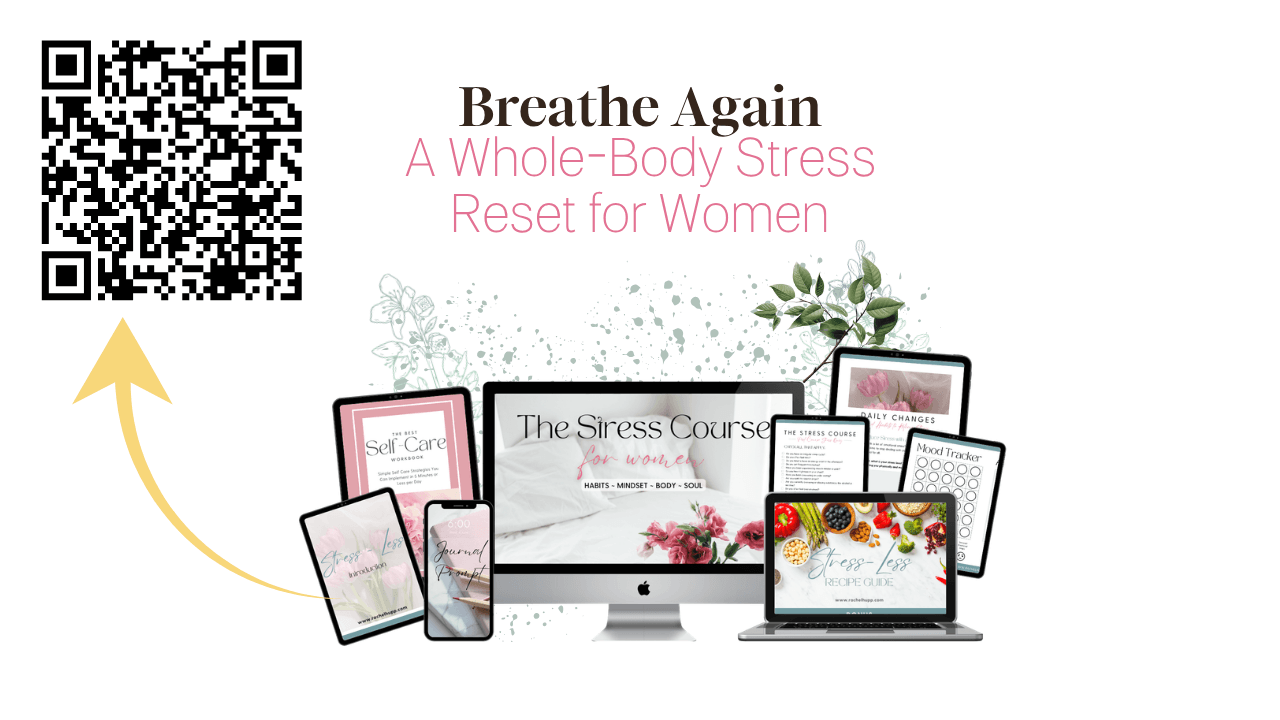
This is one of the practices in the stress course for women. It’s a whole body reset that gives you tools like this one and goes much deeper into why they work and how to build them into your actual daily life, instead of just reaching for them when you’re in crisis mode.
It walks you through what chronic stress is actually doing to your body and your mind, not to scare you, but because understanding what’s happening underneath the surface is the first step toward changing it. It gives you daily habits that are small and sustainable and genuinely supportive. It goes into mindset, because the stories we tell ourselves are one of the most powerful drivers of the stress response, but also one of the most changeable. It brings in journaling and self-care and more natural approaches to stress relief, real tools grounded in both yoga philosophy and practical wellness. It includes movement, breath work, meditation, and yoga practices that work directly with your nervous system, not around it.
There’s also a bonus stress quiz to help you understand where you’re starting from, a recipe guide, affirmations and mantras, and what I call power thoughts, because words matter, along with guided meditations. It is a whole body reset, and I invite you to go check it out. If something in this episode landed for you, the link is below, or you can visit rachelhupp.com/stressless.
Get the Course: rachelhupp.com/stressless
Before You Go
You are not failing at stress management. You’re a whole, complex, deeply feeling woman who’s been carrying a lot, probably for a long time, probably without enough support, and probably while also taking care of everyone else around you.
The nervous system doesn’t need to be fixed. It needs to be heard, to be supported. It needs the conditions to finally, actually rest and reset. And you deserve to find out what your life feels like when it does.
“You deserve to find out what your life feels like when your nervous system finally gets to rest and reset.”
If you are in that season right now, the one where something has to change but you’re not quite sure what yet, you are exactly where you need to be. There is a way through that doesn’t require you to figure it all out at once.
One breath at a time. That’s where we start.
I’ll see you in the next episode. Until then, take good care of yourself. You deserve it.
One breath, one moment at a time, we return to ourselves.


Be the first to comment