


By Rachel Hupp Cline | April 7, 2026

So many women I talk to have spent years being dismissed by doctors, told their symptoms are in their head, or left feeling like their body is broken. If that sounds familiar, this episode is for you. I’m sitting down with Jen Tullo, a bioregional herbalist and clinical nutrition master’s student, to talk about self-empowered healing after chronic illness and how to rebuild trust in your own intuition while still partnering with healthcare providers.
Jen shares her experience with POTS and dysautonomia, describing years of being dismissed and misdiagnosed from age 15 until finally receiving a diagnosis in 2021. We explore how to reframe “wrong turns” as informative learning experiences, remove moral judgment from health decisions, and align your choices with your personal values and needs.
Whether you’re navigating chronic illness, feeling disconnected from your body’s wisdom, or struggling to advocate for yourself in the medical system, you’ll walk away with a practical framework for making values-based decisions about your health.
You can watch on YouTube, listen on Spotify, or keep reading below.

Listen on Spotify: Stop Outsourcing Your Health with Jen Tullo
Editor’s Note: This interview has been edited for length and clarity. Speaker names are color-coded for easy reading.
In This Episode:
Healing Through Self-Trust
Rachel: Hello and welcome back to Radiantly Rooted with Rachel. Today I am sitting down with Jen Tullo, a bioregional herbalist, master student of clinical nutrition, therapeutic yoga trainer and guide, and registered yoga teacher. So welcome Jen. So excited to have you here.
Jen: Thank you so much. I’m excited to be here.
Rachel: So I’ll read a little bit of Jen’s bio and then we’ll dive right in. Like so many who suffer with chronic disease, Jen struggled for years to be seen, heard, and effectively treated in a medical system that wants to own the rights of healing, but doesn’t dwell in the world of wellness. After a 25 year self-empowered journey towards vitality, she’s learned to love the ride and also to love sharing the resources, tips, tools, tricks, and natural healing. These days, she works in classrooms, at health events, leading workshops, and in one-on-one consults, encouraging others to discover their own healing power through natural medicines and local foods, and reconnection with local ecosystems, farmers, wild spaces, and community.
Rachel: So it sounds, Jen, like stepping back into your own power when it comes to your health in a holistic way has been really powerful for your journey. Can you tell us a little bit more about that?
Jen: Yes. I think that like many of us who struggle with a chronic illness or even just a tricky illness that they ended up resolving, but moved through a system where the timing and the answers were external, you know, dictated by the system outside of our bodies, outside of our control, that coming back to our own wisdom, that pearl within, that intuition and that self-empowerment is where the healing is. It can feel a little bit like there’s a lot of responsibility there. A lot you have to look at and sort through information wise. But each thing you learn really builds that foundation of trust of yourself. And I think that’s where a lot of the healing happened for me in my journey, and that’s really what I pass along to my clients and my friends, whether they ask for it or not, is that focus on self-empowered healing and wellness.
“Each thing you learn really builds that foundation of trust of yourself. That’s where a lot of the healing happens.”
Outsourcing Your Worth, Trust, and Health
Rachel: I think that’s so powerful and I think that in so many different ways, we are taught throughout the years to kind of outsource our worth, outsource our trust, outsource our health, our wellbeing in so many different ways, and that can be overwhelming to know where to get started, finding your own pathway back to yourself, and that intuition and that trust and your inner voice.

Partnering With Practitioners
Jen: Yes, I agree. I think I hear that time and time again, and it’s really hard to kick the habit of asking someone else, even an expert or someone in the field working in a particular area of medicine, asking their opinion or perspective, and remembering that you have the choice to decide what’s right for you. You have that need to answer your own call even. And sometimes when we ignore that, you know, we get stuck in further sickness or we know what we’ve heard from a practitioner, you know it. I’m not saying don’t listen to your doctors and your professionals. What I’m saying is that it’s a relationship. It requires their understanding and representation of what you need for yourself and your ability to speak to that, to share that with someone trusted and for both of you to be working in the same direction on where you find common ground about which wellness aspects are important to you and which ones are maybe not.
Meeting People Where They Are
Jen: It’s really interesting when I work with people, the way in is understanding what they need, what they want, and what they can do at that time in their lives. You know, what they can take on, what their interests are, because sometimes there’s a way in that way, like, ooh, you know, you can try this thing or that thing.
Rachel: I just wanted to know more about your path, your journey, how you’ve gotten here, and how others can perhaps get started on this path when they realize that they have lost that sense of inner trust. They have lost that connection with their inner voice, and they may be at a place in their life where now they are interested in taking on more control over their own health sovereignty. And they’re not even sure where to start or what that looks like. And maybe to your point, they didn’t even realize that not taking their practitioner’s advice verbatim, perhaps taking the option to do more research or get a second opinion, or find other avenues of support, they may not even know that that’s an option. So I think that can be really eye-opening to recognize that we ultimately are responsible for the choices that we make over our own health decisions.
“You have the choice to decide what’s right for you. Healthcare is a relationship, not something you outsource.”
Jen’s POTS Journey: 25 Years to Diagnosis
Jen: I have POTS, I have dysautonomia. Lots of people know what POTS is, but I’ll explain it real quick. It’s a dysregulation of that autonomic nervous system, the nervous system that controls our sweat, our tears, our hormone regulation, our heartbeat, our blood pressure, our digestion. You can imagine that when that system is either in fight or flight all the time or in freeze all the time, the system is either overactive or disabled. And for a lot of POTS people, it alternates between the two without control.
Jen: My symptoms first showed up when I was 15, and of course I was told like a lot of women, unfortunately, that it was anxiety, hysteria, emotional imbalance. And of course it’s all those things because chemically and electrically, there are things going on in my body that were failing. I was 15 in 1997. I was not properly diagnosed. No one found it. I went to cardiologists. I saw every expert you can imagine, and I finally got diagnosed in 2021.
Rachel: Wow.
Looking to Other Resources
Jen: I think the only reason is that with the influx of COVID, POTS went up. The prevalence of POTS went up. So doctors were starting to see it everywhere. And also I had a brilliant doctor who found it. So thank you Holly Kelt. But in the process of that journey from the age of 15 really on, I was unseen, unheard so long that I had no choice but to look to other resources. And I really think that that’s pretty common, that the people who come to me, clients, friends, they tend to have been through a similar thing. I do think it’s a common story in our current system and they are out of tools and out of resources.
Learning From Missteps
Jen: I think it starts with that knowing and that trusting that something’s off, that that information that you’re getting or the method that you’re trying, whatever it is, isn’t working optimally. And I think my advice would be listen to that first, trust that, and trust that everything that you’re trying and everything you’re doing is building toward healing. Even if one thing winds up being just an absolute disaster. Believe me, I’ve had a ton of those. Where you try something and you’re like, oh, this is gonna be it, and then it makes you more sick or it throws off something else. Those are all learning experiences that contribute to this path of self-discovery, of mindfulness.
“Everything you’re trying and everything you’re doing is building toward healing. Even the disasters are learning experiences.”
Celebrate the Disasters
Jen: I think that we should, on a regular basis, get together with our friends and celebrate things we did that really resulted in disaster. I think we need to elevate those experiences because those are what make us who we are. Those are what build our sense of humor and our endurance. So I think trust yourself, laugh it off when things don’t work. Surround yourself with people who are supportive and people who maybe you trust their approach. And that’s different for everyone. It’s all like a magical system of interaction. We all need different personalities, different energies, different information will come through. Maybe you’ve heard it the same way 50 times from all 50 of your friends, but it comes in a dream in another way. Great. Wherever. Trust it.
Mindset: Gap vs Gain
Rachel: Before we do, I wanna touch on one thing really quick that just to come back to what you were saying about celebrating when we go down the wrong path, when we find something that is not serving us. I was reading the other day about the difference between the gap and the gain. You can think about it like, this is where I am, I’m not where I want to be. Or you can think about it as an opportunity. This is where I am and this is where I want to be, and these are the opportunities that I have to get there. This is where I took the wrong path. This is the thing that I tried that didn’t work. I can focus on the negative side of that, or I can focus on what I learned from it, like you said, or how I can use this as an opportunity to grow, to develop, to learn more about myself, to redirect and maybe guide me closer to the path that really does guide me to where I ultimately want to be.
Dismantling Good and Bad, Right and Wrong
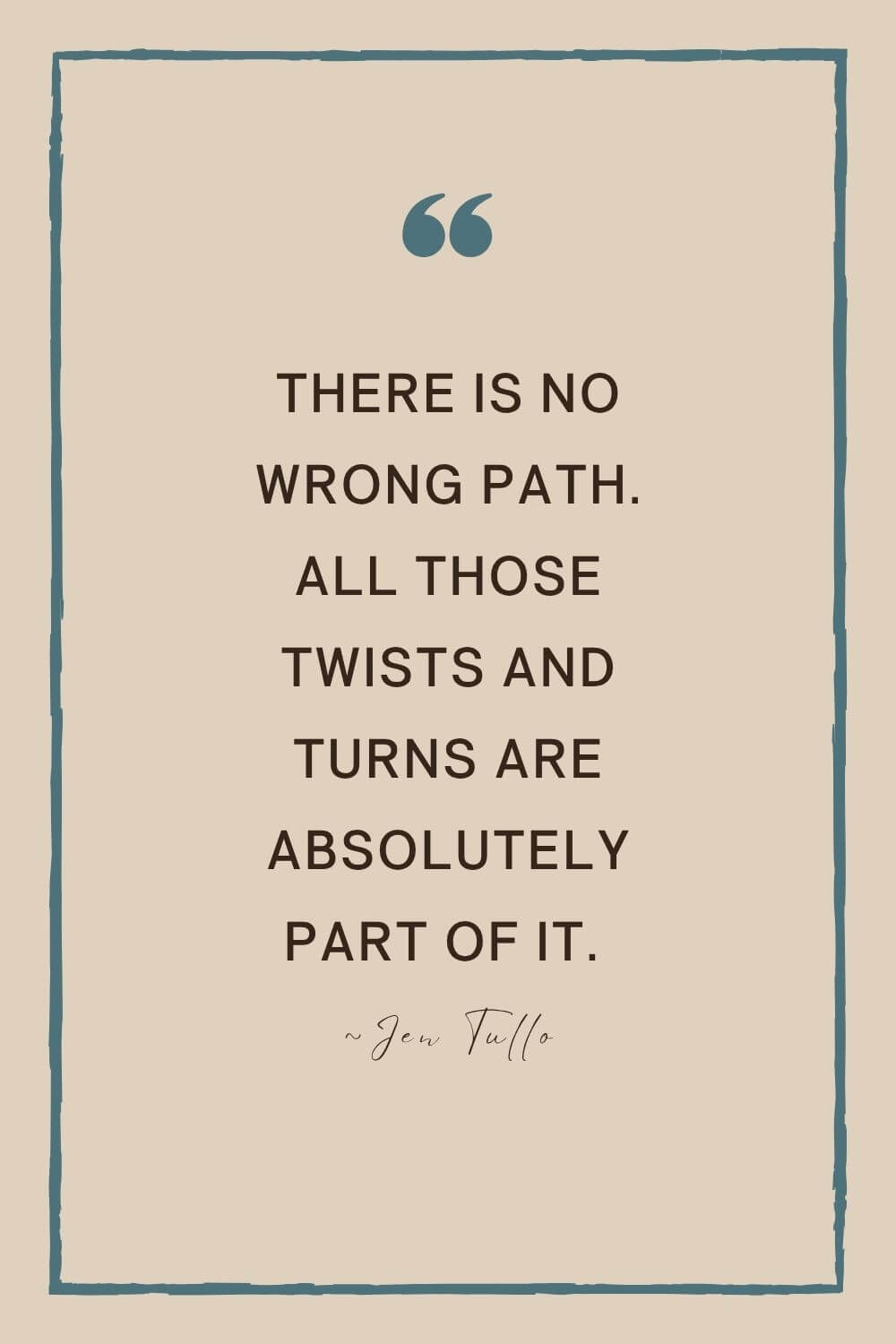
Jen: I love that perspective and for myself have been dismantling that good, bad, right, wrong. I like to think of it maybe as there is no wrong path. The path we’re on, even if we backtrack a little bit, if we were to map it on Google over a long period of time, we would see that all those twists and turns absolutely are part of it. And I agree we can appreciate where we are in this moment, like taking that mindfulness and embodying it and saying, okay, I am here. I can appreciate what I’m going through now. I can look at those opportunities, like you mentioned, for taking all different kinds of directions and instead of looking at a choice as being good or bad, or right or wrong, maybe just like a cause and effect. I’m gonna make this choice. It could have this effect, or this effect, or this effect, whatever it is. I’m good with that, and then celebrate that choice regardless of the outcome. You made a choice. It’s going to benefit you, whether as an example of what not to do or as, oh wow, I had this experience I didn’t even know I could have. Or maybe it goes exactly as you planned. But I would say the things that we traditionally think of as the wrong turn are the most informative, most powerful experiences we can have. Transformative.
“There is no wrong path. All those twists and turns absolutely are part of it.”
Action vs Analysis Paralysis
Rachel: Oh, yes, I totally agree with you there. Once we know what we don’t want or know what doesn’t work or know where we had what we might consider a negative experience or less than optimal experience, it gives us that feedback to redirect. And more importantly, not only did we make a choice, but we took an action instead of just staying in that analysis paralysis or wondering or thinking, you know, what do I do? What do I do? What do I do? Or we’re stuck and we’re not taking action. Taking action in any direction is better than no action at all.
Jen: Yes. I love that. Yeah, and I mean, I think there are times where we can listen to that part of us that’s just maybe it’s not quite the right time yet to act, and I agree with you when we get in that state of cyclical thinking, stalling, then choosing something, I do think that’s when it’s helpful to take the morality out of it. Whatever it is you’re about to do, instead of looking it through the filter of right or wrong or good and bad, because people get in this, I wanna make the right choice.
Values-Based Decisions
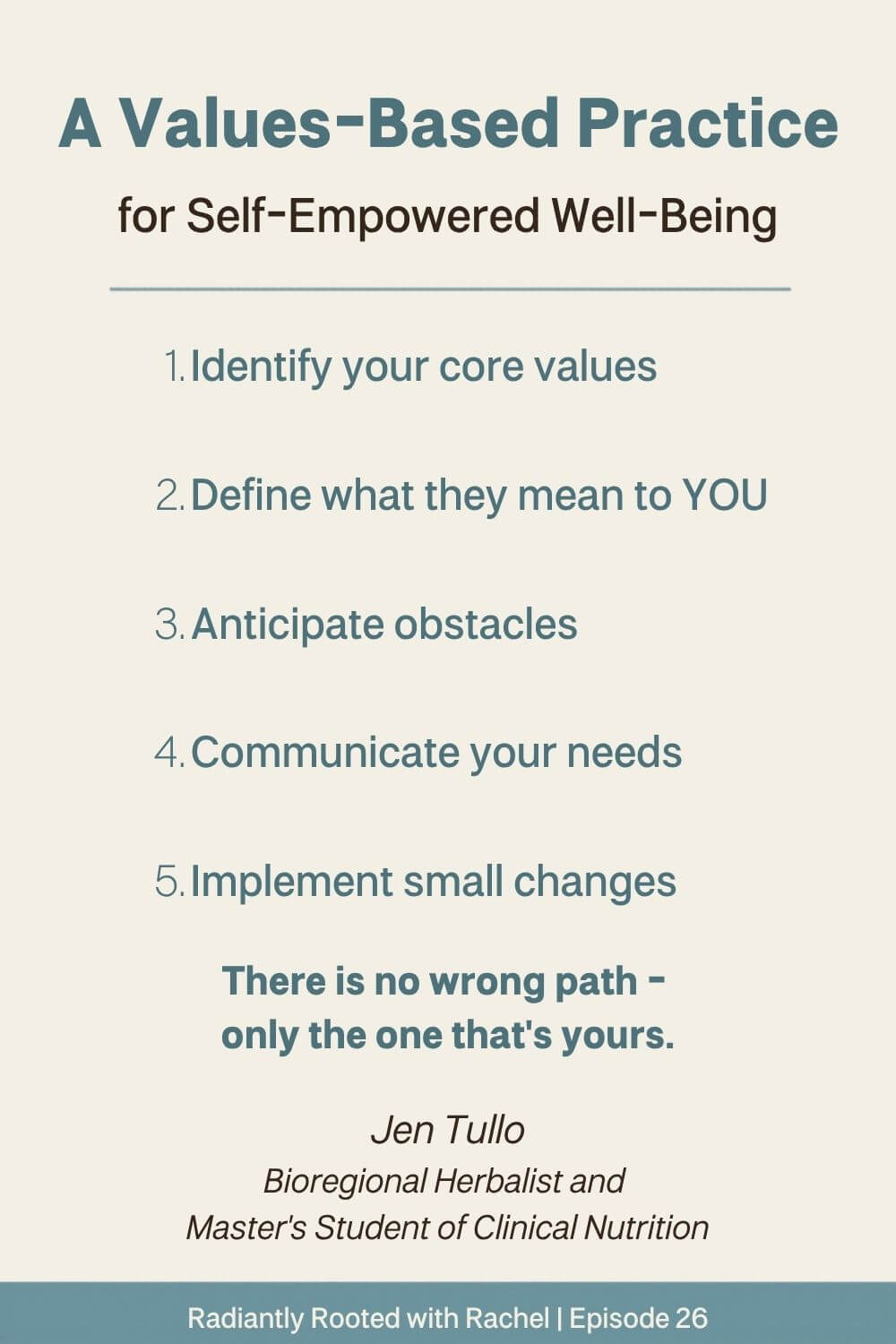
Jen: Make the choice that aligns with your personal values and literally ask that question. Okay, so what are my values? What are my needs? How can I align my life with those values and needs? And then each decision you make, what are the values and needs in that moment? And does this path or this choice that I’m about to make align with those values? And they are absolutely different for everyone. And when I say values, I don’t mean beliefs, I mean needs. What do you value most in your life? What do you need most in your life? And how can you align your everyday living practices around those values?
Rachel: Yeah, and I think that also brings up something you mentioned earlier about meeting yourself where you’re at and recognizing where you are. And so building on that, like you said, knowing what your values are, knowing what’s important to you, knowing what your capacity is, where you are right now, and what you have to offer, what you have to give, what you’re able to receive.
Jen: I love that. I hadn’t considered that filter before, that lens where you’re, what you have to give and what you have to receive. I love that.
The Values Work Framework
Jen: I do frequently encourage clients if they haven’t done values work before to start there. Very few of us have a values elevator pitch where if someone walked up to us and said, what are your top five values? And again, I don’t mean beliefs or even principles. I mean, what are the things you value most in life and you prioritize. And I think that starting there, you can just journal and some people like a really literal approach. I do. I have a whole series of questions. If you’re interested I can send them to you. It’s a method that is, I think, unique, but also it’s quick and it’s simple. And once you do it once, you have that process forever.
Identifying Your Values
Jen: In general, if you ask yourself, there’s like big questions like what are you missing in your life? What is one word or one term to describe a longing that you have, especially if you think it’s not possible? If the first thing that pops up, you sweep under the rug of yeah, I can’t do that, I could never do that, I could never have that, that’s the thing. That’s the thing that’s making you sick. That’s the thing you gotta pay attention to. And then what did you once have that you miss or you really long for and that you wanna bring back into your life? And I would say it’s really careful, like be really careful not to make this dependent on someone else. So if it’s a person, set it aside. I hear you on that. That’s a heartbreak. I feel you. I wish I could keep all of my friends in little cages in my basement. Right? Just kidding. Nearby. But yeah, make this about a concept or a feeling versus reliant on other people to fulfill these values because these are your values.
Defining, Communicating, and Implementing
Jen: And what is something that you’ve never had and you’ve always wanted and you would like to prioritize more in your life, or something that you’re doing right now that you want to keep at the top of the list of the things that are important to you. And it’s normal to come up with like three or four or five, sometimes 20 answers, but I would say practice moving through the process of identifying the word first. And then giving it a definition. If you’re literal, you like a really specific, bulletproof definition that when you read it, it sounds like right out of Webster’s dictionary, but it’s like super precise and then you can write some antonyms under it. You know, here’s what it isn’t. That’s a very helpful exercise.
Jen: And then the follow up questions are what walls are you gonna run into if you try to prioritize this value? What stops are gonna be there? Who do you have to enroll in your life to make this happen? And that’s where that definition comes in. If you have a really clean definition of what you need and what you want, when you communicate that, especially to a partner or any children living in your house or like whatever, wherever you’re seeing this shift in relationships, being able to say it clearly is imperative. Because if you are not able to clearly tell people what you need, they can’t help you in your journey to meet that need. And again, we’re not relying on other people, but we are in relationship with others. So that need communication is important.
“If you can’t clearly tell people what you need, they can’t help you in your journey to meet that need.”
Small Changes, Big Impact
Jen: And then once you’ve done the identifying your values, defining them, identifying in advance some obstacles, then implementing the values into your life in really simple terms. Like looking at your space, what’s one thing you could change about a space that you’re in, whether that’s your office or your kitchen or whatever, that would align with this value? And this is a place for creativity. Like there’s no right answer. Whatever that is for you, this is where you get to listen to your intuition. And then like where in your physical practices could you align with this value? A lot of times that can look like a meditative practice or breath work, kind of mindfulness, drawing it into your awareness with the breath or with a mantra practice. And when I say mantra, in this case, I’m using modern mantra, like more like repeating an intention. And then it can also look like, where in your schedule could you bring this alignment to life or this value into alignment?
Jen: Slowly implementing the value, starting with the one at first, which will be enough. And you’ll, and even with those small little ways to approach it, it’ll have a huge impact. Like just huge. People who do this work and move through the process and get to that lifestyle implementation report huge shifts. Because it’s something we never give to ourselves, is that permission to prioritize what’s truly important to us.
Rachel: I love it. I love it. And not only are you mentioning coming back to our own core values and to what we were talking about earlier, that builds on that foundation of self-trust and tuning into your inner voice or intuition. But beyond that, starting to piece by piece build your life around those core values. So many of us, like you said, never do that values work and it is so powerful, but also it’s something that is uniquely yours. Each and every one of us is gonna have a different path, and that’s going to help you make those choices that we were talking about earlier so that you are more clear on, even if it doesn’t go a certain way you would hope for it to go. It’s valuable. You learn something. You’re living in alignment with your core values. And to your point, there are people like you who can support along this journey.
Work With Jen Tullo
Ready to step back into your power when it comes to your health? Jen offers one-on-one consults, herbal medicine guidance, and values-based wellness support.
Visit The Blackberry Herbarium
Learn about one-on-one consults, herbal workshops, and the Cyanwood Community for ongoing support.
Community Support in the Shenandoah Valley
Jen: Oh, yeah. And we live in such an amazing place for access to support. If you live in Harrisonburg or the Shenandoah Valley, there are so many people doing the work of collective healing from lots of different angles, and I bet really that’s going on everywhere. I’m just like hyper aware and grateful to the people here who are prioritizing that. Not in a like it’s the right thing to do kind of way, but more in a collective wave. There’s an energy here that people are like, oh, we need this. And I do think it’s the tree spirits here and the green and the mountains and the magic that’s inherently environmentally here. But all that aside, there are so many people we can work with in this community. You’ve probably interviewed most of them.
Rachel: I may have.
Jen: Yeah. So there are lots of resources here and all different kinds and approaches, so I think trusting your intuition there too and working with people that align with your interest and approach or give you the freedom to be open to find your own. I think it is key.
How to Work With Jen
Rachel: So Jen, if our listeners wanted to get in touch with you, find out more about the work you do or even work with you directly, what are some of the ways that you can support them or they can find you?
Jen: So I enjoy working with people one-on-one. If they’re interested in a consult, they can reach out to me either on our website at theblackberryherbarium.com, or email me at theblackberryherbarium@gmail.com. Or if they’re looking for community support, self-care practices, nutritional programming and group work, then I would recommend checking out our Cyanwood community, which is an online intentional living space designed to prioritize connection and self-care that is launching April 1st with my friend and colleague, Lindsay Erickson. For those of you in Harrisonburg, you probably know her, she is now in South Carolina, but we still very much work closely together and we are very excited to launch this new platform. And again, that’s available. You can access the link on theblackberryherbarium.com. So there’s lots of information there.
Rachel: That’s so exciting and I love that there’s the community aspect. I love that you’ve got the one-on-one support available, so there’s really something to meet people wherever they are. And I will include all of these links down in the show notes so you can find them very easily.
Final Words: Trust the Information You Receive
Rachel: And so I think we’ve had such a great conversation today, Jen. Is there anything on your heart that you would like to leave our listeners with before we let them go?
Jen: That’s a great question and I think I’ll just come back to that trusting the information that you receive in yourself, those moments where you feel your body maybe resist or accept. Listen to those, trust those, and know that at least from my perspective, there is no right or wrong answer. It is all inside a world of opportunity as you put it, Rachel.
“Trust the information that you receive in yourself. There is no right or wrong answer. It is all inside a world of opportunity.”
Rachel: Yes. Thank you so much for joining us today, Jen, and to all of our listeners. I hope you’ll go check out the Blackberry Herbarium to find out more about how you can work with Jen more closely, learn more about the work that she’s putting out into the world, and I will share that link down below and we’ll see you next time.
About Jen Tullo
Jen Tullo is a Bioregional Herbalist and Master’s Student of Clinical Nutrition, Therapeutic Yoga Trainer & Guide, 200E-RYT, 500RYT, and YACEP. After a 25 year self-empowered journey toward vitality following years of being dismissed in the medical system, Jen now works in classrooms, at health events, leading workshops, and in one-on-one consults, encouraging others to discover their own healing power through natural plant medicines, local foods, and reconnection with local ecosystems, farmers, wild spaces, and community. Jen is especially interested in nourishing folks for their life purpose and teaching self-empowered vitality with tips, tricks, hacks, and group/one-on-one support to embrace the whole person on their wellness journeys.
Connect with Jen:
Website: The Blackberry Herbarium
Email: theblackberryherbarium@gmail.com
Cyanwood Community: Available through The Blackberry Herbarium website
Instagram: @the_blackberry_herbarium
One breath, one moment at a time, we return to ourselves.